Thursday, November 19, 2026
What If the Algorithm Isn't Your Biggest Problem?
Etsy sellers are blaming algorithms for falling sales, but my Etsy revenue is up 122%, eBay sales are up 138%, and both Pinterest accounts are growing. Here's why I focus on a connected Sales Ecosystem instead of chasing algorithms.

What If the Algorithm Isn't Your Biggest Problem?
Everywhere I turn lately, I'm hearing the same thing from online sellers:
"Etsy changed the algorithm, and my sales disappeared."
"eBay isn't showing my listings anymore."
"Pinterest has stopped sending people to my content."
I've talked with sellers who are completely changing what they sell because they're convinced the algorithm no longer likes their products. Others are spending thousands of dollars on advertising or coaching, hoping they'll finally figure out how to get their sales back. And some are giving up on their businesses altogether.
It honestly makes me sad. Because while all of these conversations have been happening, I've been looking at my own business statistics.
And I'm seeing something very different.
My Etsy revenue is up. My eBay sales are up. And both of my Pinterest accounts are growing.
And here's the really interesting part. I've spent much of the past 18 months doing very little active marketing for my Etsy business.
So what's different? I think it comes down to something I've been teaching business owners for years. I don't build my business around an algorithm.
The Algorithm Might Have Changed. But Is That Really the Whole Problem?
First, I want to make something clear: Algorithms absolutely change. Etsy, eBay, Pinterest, Google, and social media platforms all make decisions about which content and products people see. And those decisions can affect your business. I'm not suggesting that sellers who are struggling are imagining things.
But here's where I think we need to be careful. When sales decline, it's easy to assume the algorithm is the problem. And once you believe that, it's tempting to start chasing solutions.
Maybe you need different keywords. Maybe you need to post more often. Maybe you need to change your products. Maybe you need to pay for more advertising. Before long, you're spending enormous amounts of time and money trying to make one platform behave the way you want it to.
But what if the bigger problem is that your business depends too heavily on that platform in the first place?
Here's What's Happening in My Etsy Shop Right Now
I recently checked my Etsy statistics for the seven-day period ending November 15, 2026. And the numbers were interesting.
Compared with the same period last year:
- Visits were down 10.55%.
- Conversion rate was down 32.92%.
- Average order value was up 271.32%.
- Revenue was up 122.79%.
So even though fewer people visited my shop, and a smaller percentage of those visitors made purchases, my revenue more than doubled compared with the same period last year.
Why? One important factor was that the customers who purchased spent considerably more per order. My average order value was $90.58 (up from $27 last year).
And that brings me to something I wish more sellers understood: More views don't automatically mean more sales. And fewer views don't automatically mean fewer sales.
There are a lot of things happening inside your business that contribute to your revenue. If you're only looking at your views, you're missing a big part of the picture.
And It's Not Just Etsy
I checked my eBay statistics, too. Over the previous 31 days, I saw a sales increase of 138.1%. So while I'm hearing other eBay sellers talking about how difficult it has become to make sales, my own results have been improving.
Does that mean I never experience slow periods? Of course not! I've been selling online for more than 25 years. I've experienced plenty of slow months, platform changes, economic downturns, and unexpected challenges.
But I've also learned that I don't want my entire business depending on what one company decides to do with its search results. And that's where the rest of my marketing becomes important.
Meanwhile, Both of My Pinterest Accounts Are Growing
The other day, I was reading a discussion in a Pinterest group. People were talking about how their impressions and engagement had flatlined. Some were frustrated. Others were worried that Pinterest had changed something that was hurting their accounts.
So I went to look at my own statistics. Here's what I found:
My established Mandaline Pinterest account, for October 16 through November 15, 2026, showed:
- Impressions up 67%.
- Engagements up 93%.
- Outbound clicks, up 703%.
- Saves, up 258%.
And my newer Amanda Boggs Coaching Pinterest account?
- Impressions up 1,059%.
- Engagements, up 735%.
- Saves, up 650%.
Now, these are two very different accounts. My Mandaline account has years of history and content behind it. My coaching account is still relatively new.
And I'm not suggesting everyone's Pinterest account should be experiencing the same results. But I find it interesting that while other people are worried about declining visibility, both of my accounts are growing. Especially because I don't treat Pinterest as something separate from the rest of my business.
I Don't Have a Pinterest Strategy, an Etsy Strategy, and an eBay Strategy That Operate Independently
This is where I think a lot of business owners get into trouble. They treat every platform like its own separate marketing project. They work on Etsy SEO. Then they work on Pinterest. Then they try Instagram. Then someone tells them they need an email list. And pretty soon, they're trying to keep up with five different marketing strategies that don't necessarily work together.
It's exhausting.
And when one of those platforms stops producing the results they expect, they feel like they have to start all over again. That's not how I approach my business.
I build a Sales Ecosystem.
The different pieces of my marketing are designed to support one another. My products, shops, evergreen platforms, website, content, and email marketing aren't simply a collection of unrelated activities. They're part of a bigger picture. And that matters because I'm not relying on one individual platform to do everything for me.
When Etsy Search brings fewer shoppers to my listings, Pinterest may still be helping people discover my products. When someone discovers my business through a blog post, there may be opportunities for them to learn more about what I offer. When someone purchases from me, I create opportunities for them to come back.
It's not about being everywhere. And it's certainly not about creating more work for myself. It's about making the things I already do work together.
Does That Mean My Business Is Protected From Every Algorithm Change?
No. I wish I could promise that! But nobody can. Platforms change. Customer preferences change. The economy changes. And every business experiences ups and downs.
What I can tell you is that building a business with multiple ways for people to discover and purchase from you can reduce your dependence on any one platform. That's very different from spending every day worrying about whether Etsy, eBay, or Pinterest is going to change something tomorrow. And it gives you more opportunities to keep moving forward when one part of your marketing isn't performing the way you'd hoped.
What Happens When You Stop Chasing Algorithms?
One of the things I've noticed about business owners who are frustrated with their marketing is how quickly they jump from one strategy to another.
Their Instagram engagement drops, so they decide they need to start posting videos. Their Etsy views decline, so they rewrite every listing. Pinterest slows down, so they start looking for another platform.
Sometimes those changes are necessary. But sometimes they're simply reacting to a symptom without understanding the underlying problem.
Before you spend money on advertising, completely change your products, or abandon something you've spent years building, I'd encourage you to ask yourself a few questions:
Are you relying too heavily on one platform? Are people discovering your products but not purchasing? Are you making sales but missing opportunities to bring customers back Or are you spending so much time trying to keep up with marketing that you don't have time to work on the business itself?
Those questions can reveal opportunities that have nothing to do with figuring out what an algorithm wants.
Your Business Shouldn't Depend on Keeping an Algorithm Happy
I've been building and running online businesses for more than 25 years. I started because I wanted to create an income that would give my family more flexibility. And over the years, I've learned that I don't want to spend my life chasing every new marketing trend.
I want a business that supports the life I want to live. That's why I focus on building marketing systems and assets that can continue working beyond the day I create them. It's also why I teach other business owners to look at their marketing as a connected system rather than a collection of individual tasks.
Because the goal isn't to figure out how to make an algorithm love you. The goal is to build a business that can attract customers and make sales without depending entirely on any one platform.
Before You Change Everything, Find Out What Your Business Actually Needs
If your sales have slowed down, I understand how frustrating that can be. Especially when you've invested years of work into building your shop.
But before you decide you need to start over, I'd encourage you to look at the bigger picture. Maybe you need more shoppers discovering your products. Maybe you're already getting plenty of visitors but need to improve how many become customers. Maybe you need a better way to encourage previous buyers to return. Or maybe your biggest opportunity is creating a more sustainable marketing system.
Those are different challenges, and they require different approaches. That's why I created my 5-minute Sales Opportunity Audit. You'll answer questions about your business, sales, and marketing so I can understand what's happening.
Then you'll receive a personalized report identifying:
- Your #1 opportunity to make more sales.
- Three additional opportunities worth exploring.
- One focused task to help you move forward.
Because before you spend more money, change your products, or add another marketing platform, it makes sense to understand what your business actually needs.
Find Your Next Sales Opportunity
https://www.amandaboggscoaching.com/sales-audit
Your business is too important to build entirely around an algorithm you can't control.
See other posts like this one:
Wednesday, October 21, 2026
Start Small: Why You Should Test Before You Scale Your Etsy Shop


Sunday, October 18, 2026
Physical or Digital Products? Choose the Model That Fits Your Time and Profit Goals
Saturday, October 17, 2026
What Should You Sell on Etsy? Start With a Problem People Already Want Solved
Friday, October 16, 2026
Can You Start a Successful Etsy Shop If You’ve Never Sold Anything Before?

Thursday, October 15, 2026
Everybody Wants to Be Their Own Boss. But Are You Ready to Be Your Own Employee?
Wednesday, October 14, 2026
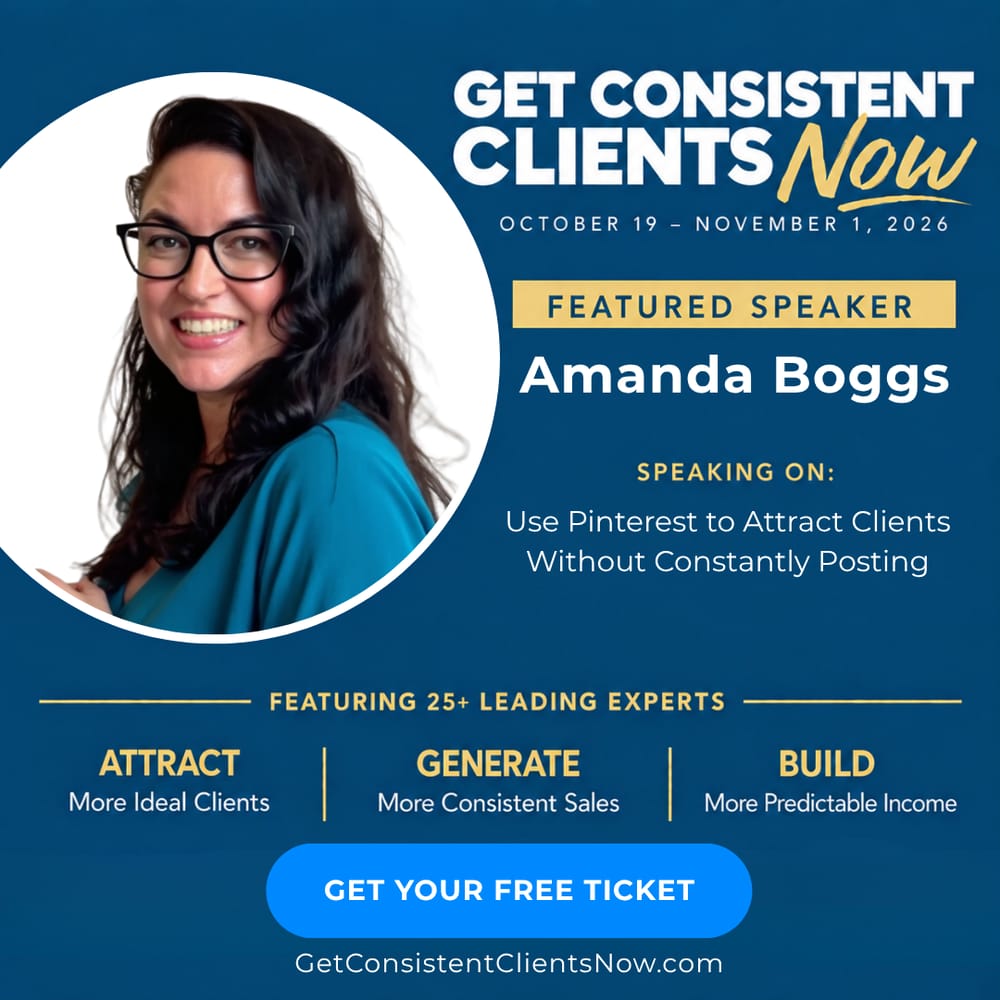
Stop Posting More. Start Getting Found: Join Me at the Get Consistent Clients Summit!
Saturday, October 10, 2026
Why One Hour With an Etsy Business Coach Could Save You Months of Trial and Error
Wednesday, October 07, 2026
The 30-Day Etsy Sprint Is Coming: Start Building an Etsy Shop That Can Actually Sell
Tuesday, October 06, 2026
Why I Built a Business That Didn't Require Me to Be Online All Day
©Amanda Boggs 2026 | All Rights Reserved
This page and any offers from Amanda Boggs Coaching are not affiliated with Etsy or Pinterest.